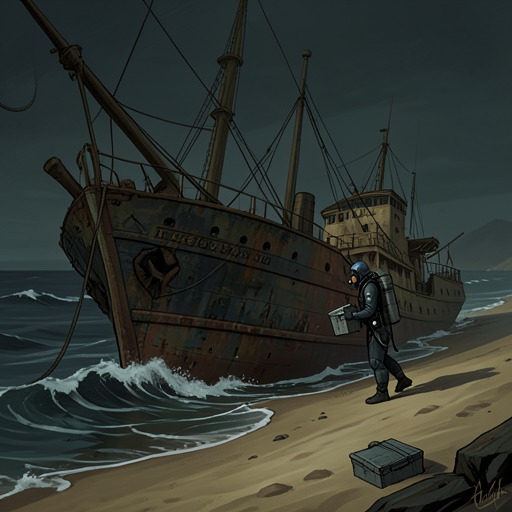
Black tin box on the wrecked ship
Young Captain Jack · The Son of a SoldierThe black tin box from the Nautilus wreck is more than a container of papers: it is the story’s compact archive of identity, marriage, property, and betrayal. Hidden beneath dirt and water in the wreck, it preserves the documents that explain why Jack Ruthven was carried ashore as a child, why Colonel Stanton has been separated from his wife Laura and son Jack, and why Dr. Mackey attempts to control the boy’s identity and inheritance. Its eventual recovery turns a chain of suspicions into evidence and helps reunite Colonel Stanton with his son and his fortune.
Hidden Archive in the Wreck
The box is discovered in a deserted stateroom of the wreck on Hemlock Bluff. The room has been stripped of movable objects and is thick with dust and cobwebs; the small closet at the foot of the bed is difficult to locate because its knob has disappeared. The searcher tests both ends of the room, finds a hole where the knob once was, and uses a bent nail to pull open the concealed door. Inside, dirt has hardened into a solid mass because water and soil entered through a crack at the top. Digging through it reveals a heavy box painted black.
The box is secured by a small padlock. After bringing it out and brushing it clean, the searcher tries keys from a bunch carried in his pocket until one fits. This physical sequence matters because the box is not found by chance alone: it is recovered through deliberate exploration, mechanical ingenuity, and the willingness to enter a neglected, contaminated space. The wreck therefore functions not merely as the scene of an old disaster but as a damaged repository whose hidden compartment still protects the past.
Contents and Documentary Force
Inside are the papers the searcher has wanted: a marriage certificate, letters from the father concerning property, and letters from the woman’s family. The documents are immediately connected with inheritance, and the searcher concludes that the fortune is his. That conclusion exposes the box’s double narrative function. The papers can establish legitimate family and property claims, but they can also be coveted, concealed, and exploited by someone seeking wealth. The same archive that can restore a family can therefore become an instrument of imposture.
The box’s papers complement the fragile objects preserved by Mrs. Ruthven. After the shipwreck, Jack’s mother is found injured on the beach with the small child in her arms; she dies at the Ruthven home without providing an identifying name beyond calling the boy Jack. Her clothing is unmarked, as is a lace handkerchief, and the only potentially identifying object is a ring whose worn inscription cannot be read even by two jewelers. Mrs. Ruthven keeps the clothing, handkerchief, and ring, while the box preserves a more explicit written record. Together, these objects form an evidentiary chain: bodily remnants and jewelry preserve traces that cannot be fully interpreted, whereas the documents can state the relationships and property rights those traces only suggest.
Dr. Mackey’s Search and Theft
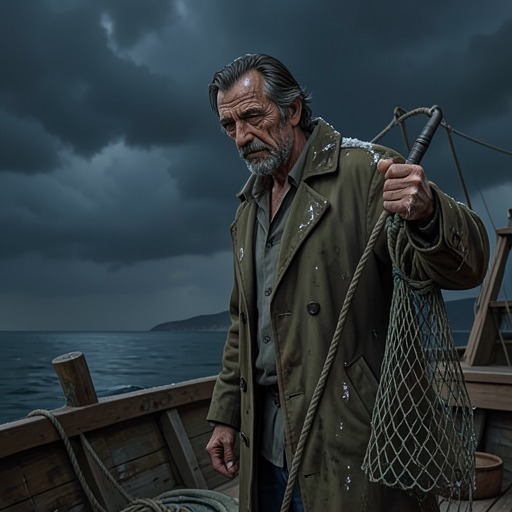
Dr. Mackey reaches the wreck through Old Ben, whom he persuades to row him there. He orders Old Ben to leave him alone for about an hour while he goes below deck and searches out of sight. When Old Ben later reports that Dr. Mackey had a tin box hidden under his coat, the box becomes a concrete sign that the doctor has not merely investigated the past but has removed something from it. Dr. Mackey’s secrecy and possession of the box intensify the suspicion surrounding his claim that Jack is his son.
The attempted seizure is explained by Colonel Stanton’s account. During lucid intervals in an asylum, Stanton told a physician about property in England coming to him and an estate in Virginia coming to his wife Laura. Stanton and Laura had undertaken the ocean voyage to obtain the property belonging to her. The physician drew out every detail he could, drugged Stanton, and later disappeared; he had also arranged for Stanton to be recorded as incurable and subject to violent attacks. In this context, the box’s documents are not neutral keepsakes. They are the legal and genealogical materials Dr. Mackey needs if he is to appropriate the property by manipulating Jack’s parentage.
Recovery and Resolution
The box remains in the hands of the outlaws who hold Jack prisoner until a battle in the mountains between Federal troops and the guerrillas kills a number of the outlaws, including his captors. Pete Gendron is also killed without revealing what he knows of Dr. Mackey’s past. When the camp is searched, the stolen goods of a trader attacked during the storm are found, along with other valuables and the tin box taken from the Nautilus wreck. The box is subsequently delivered to Colonel Stanton.
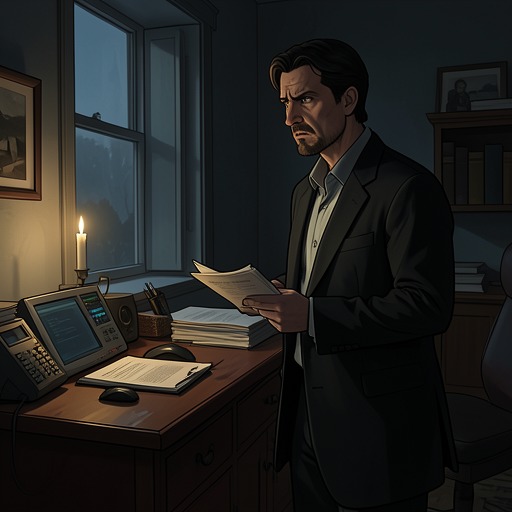
For Stanton, the return of the box is the recovery of his own history in documentary form. He examines the papers and tells Jack that his precious documents have been restored and that nothing now stands between them and their fortune. The statement links three consequences at once: the box verifies the family connection, restores the financial claim, and places the evidence with the man whose history it records rather than with the doctor who tried to exploit it.
Narrative Significance
The box is the principal object through which the novel’s identity mystery moves from uncertainty to proof. Jack first exists in competing descriptions: he is dismissed as a nobody who does not belong to the Ruthven family; he is then identified as the child rescued from the wreck; later Dr. Mackey claims him as a son; finally Colonel Stanton recognizes the possibility that he is the missing child whose mother was named Laura. Stanton’s fevered cries about a doomed ship and his request that Laura and Jack be saved awaken the wreck as a shared past, while his resemblance to Jack supplies visual suggestion. The box supplies what resemblance and memory cannot: documentary confirmation.
Its material condition also mirrors the damaged history it contains. The papers survive behind a missing door-knob, under dirt, in a flooded wreck, and beneath a lock that requires the right key. Their survival is precarious, but their meaning becomes increasingly powerful as other clues converge: Jack’s dim memory of the storm and enormous waves, the ring and handkerchief retained by Mrs. Ruthven, Stanton’s uncertain recollections after years of confinement, and Dr. Mackey’s suspicious visit to the wreck. The black box is therefore both a physical relic and a narrative mechanism. It delays certainty while making final recognition possible, and it transforms the past from a story told by interested witnesses into a recoverable record.